
Sustainability & Responsibility
OUR FRAMEWORK
Recent Sustainability Highlights
Employee Volunteering Hours
in Corporate Philanthropy through Bridge Gives
QOZ Project Sites With EV Charger Stations
3rd Party Building Certifications
Bridge Assets Covered in Risk Assessment Analysis Platform
Green Stars earned in 2025 GRESB Reporting
Qualified Opportunity Zones Workforce Units
Residents Served by Project Access at Workforce & Affordable Housing Communities
Efficiency Projects for Multifamily Strategy
Our Reporting
Bridge publishes various reports aligned with our Sustainability & Responsibility program and our Workforce and Affordable Housing program. Recent versions of our reports can be found below, and prior reports are available upon request.
Our Environmental Management System
Bridge references the ISO 14001:2015 standard to guide its Environmental Management System. The Firm uses the standard to assess current conditions, set goals, implement strategies, and evaluate progress in a continual improvement cycle. Bridge’s Sustainability Baseline Assessment conducted in 2020 leveraged this EMS to establish a phased, strategic approach tailored specifically to Bridge to strengthen our sustainability efforts. The EMS is designed to follow the Plan-Do-Check-Act cycle to integrate sustainability into its structure, culture, and business strategy. Our EMS is updated on an annual or as needed basis and continues to serve as a valuable tool for guiding our sustainability program over time.
Risk Management
Evaluating risk and opportunity are core components of Bridge’s approach to operational resilience and risk management. To support accountability and risk-informed decision-making, risk management practices and initiatives are continuously refined across the organization. This includes ongoing efforts to strengthen risk identification and assessment using analytical tools that facilitate monitoring of meaningful risks and opportunities.
The Enterprise Risk Committee is a firmwide committee responsible for identifying, managing, and monitoring risks across Bridge. The ERC oversees the Enterprise Risk Management Program and corresponding framework of 32 distinct risk areas, including S&R and Insurance / Risk Management. Risk areas are categorized using a Tier 1 to Tier 3 scale, with Tier 1 risks representing the highest priority and guiding the proactive allocation of resources to advance mitigation efforts over a 6–12-month horizon. The ERC convenes bimonthly generally to review risk assessments and monitor emerging risks through enterprise-level oversight.
Climate-related risks are evaluated as part of Bridge’s enterprise and investment risk management processes. These risks and opportunities are incorporated into Bridge’s Enterprise Risk Management framework and are assessed in coordination with the Enterprise Risk Committee as part of ongoing risk identification and evaluation processes.
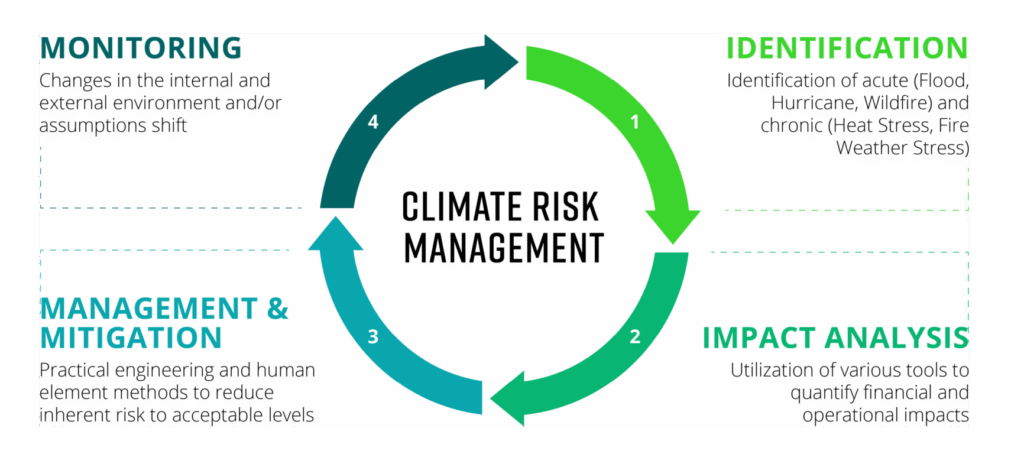
Bridge’s approach to climate governance is designed to uphold the consistent identification, assessment, and management of climate-related risks and opportunities across the Firm. Our Firm’s governance structures and our growing and evolving climate strategy include the following components.
Emissions Tracking & Reduction
To bolster data-informed decision-making, Bridge refines and expands the measurement and reporting of energy use and greenhouse gas emissions across its real estate strategies, including Scope 1 & 2 emissions and, where feasible, Scope 3 emissions. These efforts help identify opportunities to enhance energy efficiency and reduce emissions across property operations.
Climate-Related Risk Assessments
Across its portfolio, Bridge monitors and assesses physical and transition climate-related risks, informed by scenario analysis and regulatory considerations, respectively. These assessments provide an understanding of potential exposures across multiple time horizons and geographies and help inform risk prioritization and planning as local and regional building requirements continue to evolve.
Climate Adaptation, Mitigation & Resilience
As Bridge has enhanced its climate analysis and risk assessment capabilities, adaptation and mitigation planning have become increasingly important areas of focus. Efforts to strengthen asset resilience bolster preparedness for potential climate-related impacts in Bridge’s communities, enhancing both operational and business practice resilience.
Financial Analysis
Financial analysis is used to evaluate potential downside exposure associated with climate-related physical risks, including asset damage and potential impacts to rental income. These analyses consider a range of acute and chronic climate-related hazards and help inform risk prioritization and capital planning.
Risk Financing / Insurance Strategy
To complement its risk assessment and financial analysis, Bridge applies a range of risk financing and insurance approaches across its real estate assets. These approaches emphasize flexibility and cost-effectiveness and support the management of risk exposure and potential financial losses.
Renewable Energy Adoption
Bridge integrates renewable energy solutions, including solar photovoltaic systems, battery storage, and EV charging infrastructure across its strategies where appropriate. These efforts boost operational energy efficiency and asset resilience and advance Bridge’s broader climate strategy.
As climate-related risks and severe weather events continue to evolve, mitigation and adaptation remain central to Bridge’s approach to operational resilience and long-term asset performance. These complementary approaches address different dimensions of climate-related risk.
Bridge applies a risk-informed, asset-specific approach, supported by ongoing monitoring and cross-functional coordination. Physical climate risks are assessed during acquisition due diligence and evaluated on an ongoing basis across the portfolio. These assessments inform how mitigation and adaptation actions are prioritized based on asset characteristics, location, and exposure to climate-related risks.

Expanding Opportunity
Opportunity at Bridge begins with creating a workplace where employees can grow and feel connected to the Firm’s mission, fostering engagement and collaboration that strengthen understanding and participation. Guided by the B.R.I.D.G.E. Framework, we emphasize inclusive engagement within the workplace and beyond through dialogue, collaboration, shared experiences, and community engagement across the regions where we operate, encouraging employees to give back and reinforcing a culture of participation and shared responsibility that supports the long-term strength of the Firm.